
In our February 2025 article “The #1 Predictor of Success on TikTok Shop,” we demonstrated that the single strongest predictor of success on TikTok Shop is the number of affiliate posts a brand generates. The following month, we unpacked the core economic mechanics of video commerce in “How TikTok Shop Works: A Framework for Success,” which explained why the model works the way it does.
Our thesis then—and now—has remained remarkably consistent: to win on TikTok Shop, you need a lot of people talking about you, and “a lot” in this context truly means hundreds to thousands. These creators are not traditional paid media buys but commission-based affiliates, meaning the brand’s primary cash outlay is simply the cost of the sample. It is a “try before you buy” model for content creation.
Out of this large body of content, only a small portion—typically between 7% and 10%—becomes productive, generating the conversion-driving performance that turns videos into real revenue engines. Those are the assets where real investment begins, in the form of GMV Max paid ad campaigns that scale the winners. When brands do this effectively, the affiliate wins, the brand wins, and the flywheel of video commerce starts to accelerate.
Since then, the industry’s evolution has validated this view. Winners on TikTok Shop have scaled their affiliate engagement to extraordinary levels. Medicube generated 74,000 posts over the most recent 30-day period, Dr. Melaxin 47,000, and Halara 30,000. These numbers are extreme, and understandably daunting for brands just entering the channel. In recent months, we have also seen brands dive prematurely into large-scale sampling efforts, only to discover that most of the resulting content was unproductive—even relative to the low cost of a sample. Naturally, everyone is asking the same question.
How many affiliate videos do you actually need?
TikTok and various agencies often offer rules of thumb — “100 samples per item per month” or, more vaguely, “thousands of posts per month” if a brand wants to be material. While rules of thumb can be helpful starting points, at Trendio we aim to give brands more precise, analytical guidance. Given the economic model outlined above, our intuition was that the right number of videos should correlate in some form with the paid ad spend a brand was planning to deploy. So we set out to quantify the relationship between video volume and GMV Max spend using real, large-scale data rather than assumptions.
To get to the answer, we analyzed 39,000 affiliate posts across 44 GMV Max campaigns conducted in October 2025. These campaigns spanned brands of all sizes—from startups to large enterprise players—and categories ranging from beauty to home goods to automotive. For each campaign, we mapped monthly GMV Max spend against the number of videos that received at least $5 of spend within the month (Exhibit 1).
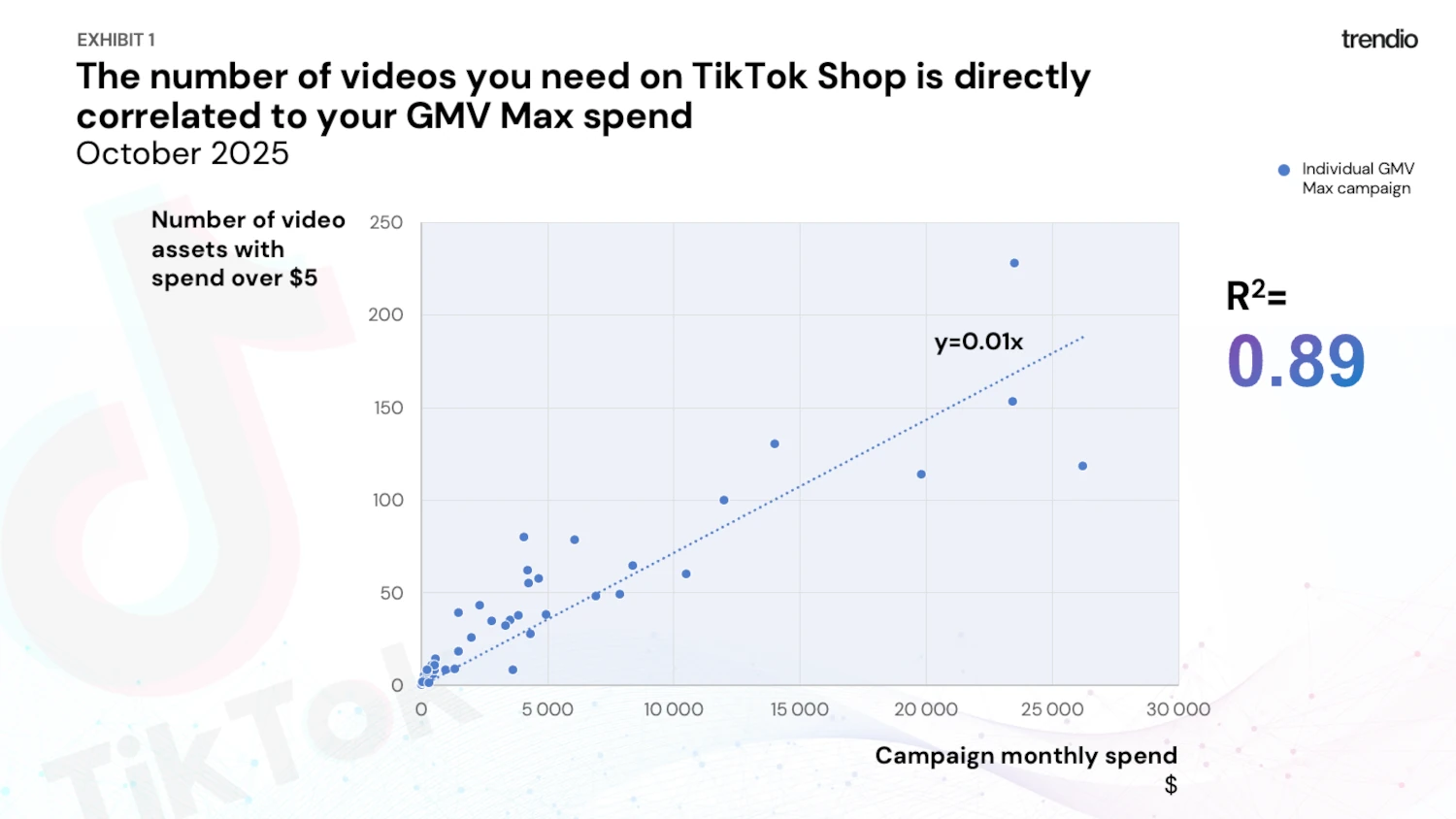
The correlation we found between campaign spend and the number of such videos was striking, with an R² of 0.89—an almost unheard-of result in marketing analytics. The conclusion is clear and unambiguous: brands need approximately 10 productive videos for every $1,000 of GMV Max monthly spend.
Knowing that only 10% of all affiliate posts tend to cross the $5 spend threshold, we can convert this simple rule into the planning number that matters: brands need to source roughly 100 videos for every $1,000 of intended monthly GMV Max spend. For the first time, the industry has a quantitative benchmark.
Why the Ratio Holds: The Algorithm’s Micro-Distribution
The intuition behind this finding is straightforward at low GMV Max budgets. When budgets are modest, the GMV Max bucket is inherently small, so only a limited number of videos are required to fill it. Producing significantly more than that yields diminishing returns.
What is less intuitive is that the relationship holds at higher budgets as well. One might assume that a small group of outstanding videos—especially those created by high-profile affiliates—would naturally absorb most or all of a large budget. Our data shows the opposite.
Across the 44 campaigns, the correlation between total campaign spend and average spend per video was essentially zero, at an R² of 0.04. In fact, 91% of campaigns had average spend per video below $35, regardless of total spend level. Even more telling, in campaigns with more than $10,000 in monthly spend, the top-performing asset never accounted for more than 20% of total spend.
This reflects something fundamental about social commerce: TikTok does not scale a single winning video to the entire world. Instead, it distributes spend across a diverse range of creative assets to match the right video to the right customer at the right moment. Scale comes not from a hero asset, but from creative variety, which allows the algorithm to optimize across countless micro-audiences. We will explore this micro-segmentation dynamic in an upcoming article.
A New Planning Standard for the Industry
With this research, brands finally have a reliable formula for sample planning on TikTok Shop. For every $1,000 of monthly GMV Max spend planned, brands should expect to source roughly 100 affiliate videos. This is the volume required to fill the testing bucket, surface enough productive assets, and unlock scalable results.
In hindsight, the answer seems almost surprisingly simple. But it took 39,000 videos and dozens of campaigns to uncover it. Now the industry has a benchmark grounded in data. And with that, planning for TikTok Shop just became a little easier.
Practical Note on Creative Shelf Life
One nuance worth noting is that affiliate videos vary in how long they remain productive. Some continue generating discovery and conversions for several months, while others fade more quickly. Our working assumption is that the average useful life of an affiliate video is one to two months, which means brands may not need to source the full benchmark volume every month. In many cases, refreshing roughly half to two-thirds of the benchmark is sufficient to sustain GMV Max performance. We will publish deeper analysis on creative longevity and refresh rates in a future article.
About Trendio
Trendio is a video shopping technology provider and agency that works with brands across categories on TikTok Shop, YouTube Shopping and video web embedding. Trendio combines proprietary AI solutions with channel expertise to identify and engage the best affiliate creators for every brand in every channel, manage their entire video creation process, optimize brands' own video posts using video AI, manage paid ads for maximum returns and deliver best-in-class tracking. For more information, visit www.trendio.ai.
About the Author(s)
Alex Perez-Tenessa is the Founder & CEO of Trendio. Prior to Trendio, he was the VP of US Prime Video at Amazon, VP of Beauty and Personal Care at CVS Health and Partner in the Retail Practice of McKinsey & Company.