
One of the most common questions brands ask us is not how to scale TikTok Shop — it’s whether they should enter the channel at all.
That hesitation is understandable. TikTok Shop introduces new economics: affiliate commissions, platform fees, free samples, and paid amplification through GMV Max. For teams accustomed to evaluating channels through familiar metrics like ROAS, the decision can feel opaque. Is TikTok Shop incremental? Is it efficient? And how does it compare to channels they already understand well?
In this article, we argue two things.
First, TikTok Shop should be evaluated primarily as a customer acquisition channel, not a repeat-purchase or ROAS-optimized channel.
Second, and more importantly, it is now possible to estimate TikTok Shop customer acquisition cost before launching, with a level of simplicity and consistency that was previously unavailable.
Together, these ideas make it possible for brands to decide whether to invest in TikTok Shop with far greater clarity and confidence — before committing a dollar to the channel.
Why CAC Is the Ultimate Metric for TikTok Shop
Brands that succeed on TikTok Shop tend to share one clear perspective: they treat it first and foremost as a customer acquisition channel.
On platforms such as Amazon, performance is dominated by repeat behavior. For many established brands, 70–80% of purchases come from customers who have already bought before. ROAS can look attractive, but much of that spend is non-incremental, capturing demand that would have materialized anyway.
TikTok Shop is structurally different. Across categories and price points, roughly 90% of buyers in any given month are new to the brand. That level of incrementality is not incidental; it is the core mechanic of the channel. TikTok Shop is built around discovery rather than prior intent, and it consistently introduces brands to customers they would not have reached through traditional performance channels.
In that context, the metric to optimize is customer acquisition cost.
The Decision Criterion for Entering TikTok Shop
If TikTok Shop is evaluated on customer acquisition cost, then the economic question is straightforward: can it acquire customers more cheaply than alternative channels?
If the answer is yes, brands should invest decisively. If the answer is no, they should not. Until recently, however, this comparison was difficult to make. TikTok Shop CAC could only be measured after launching, which required committing budget, distributing samples, activating creators, and waiting long enough for results to stabilize.
For many brands, that uncertainty alone was enough to delay entry. The inability to estimate CAC in advance made TikTok Shop feel speculative rather than strategic.
The Operational Relationship That Unlocks CAC
Over the past few months, we have focused on understanding one of the most critical determinants of TikTok Shop performance: the volume of affiliate video content a brand must plan to source.
On TikTok Shop, GMV Max is the primary driver of outcomes, and its performance depends almost entirely on the breadth of video content available for algorithmic matching. In practice, success is no longer about finding a single breakout video, but about maintaining a sufficiently large and diverse set of videos to reach many micro-audiences in parallel.
Prior to our analysis, brands typically tied content volume to revenue targets, assortment size, or intuition. Our data shows those heuristics miss the governing variable. Across brands and categories, based on analysis of over one million GMV Max video-week observations, the required volume of affiliate videos is tightly and predictably linked to planned GMV Max spend, with a strong and stable relationship (R² ≈ 0.9)1. To sustain $1,000 of GMV Max spend per month, a brand must plan for approximately 70 new affiliate video posts per month.
This relationship turns content planning — and the associated sample investment — into a calculable input directly linked to planned paid spend rather than an ad-hoc guess. It is this linkage that makes TikTok Shop economics modellable in advance.
A Predictive CAC Formula for TikTok Shop
Combining the required volume of affiliate video content with sampling costs, platform fees, commissions, and assumptions about GMV Max return allows us to estimate TikTok Shop customer acquisition cost before launching.
The resulting formula is:
We will provide the algebraic derivation in a short appendix at the end of this article. What matters here is not the math itself, but what it enables. Once video volume is tied directly to planned GMV Max spend, the CAC expression collapses into a simple, closed-form equation that is independent of overall investment volume or program size.
As a result, the formula is surprisingly simple — and broadly applicable. It applies consistently across categories and price points, and it can be implemented easily in a spreadsheet or calculator. The only substantive assumption required is the ROI a brand expects to achieve on GMV Max. The table below provides directional ROI ranges based on observed patterns across TikTok Shop programs, intended as a planning reference rather than a statistical forecast.
| Low awareness brand | Mid awareness brand | High awareness brand | |
|---|---|---|---|
| Lower investment (<$10K/mo) | 0.5-1x | 1-2x | 2-3x |
| Higher investment (>$10K/mo) | 1-2x | 2-3x | 3-4x |
To build intuition around the mechanics of the model, the exhibit below shows how CAC — expressed as a multiple of unit price — varies with sample cost under different GMV Max ROI assumptions.
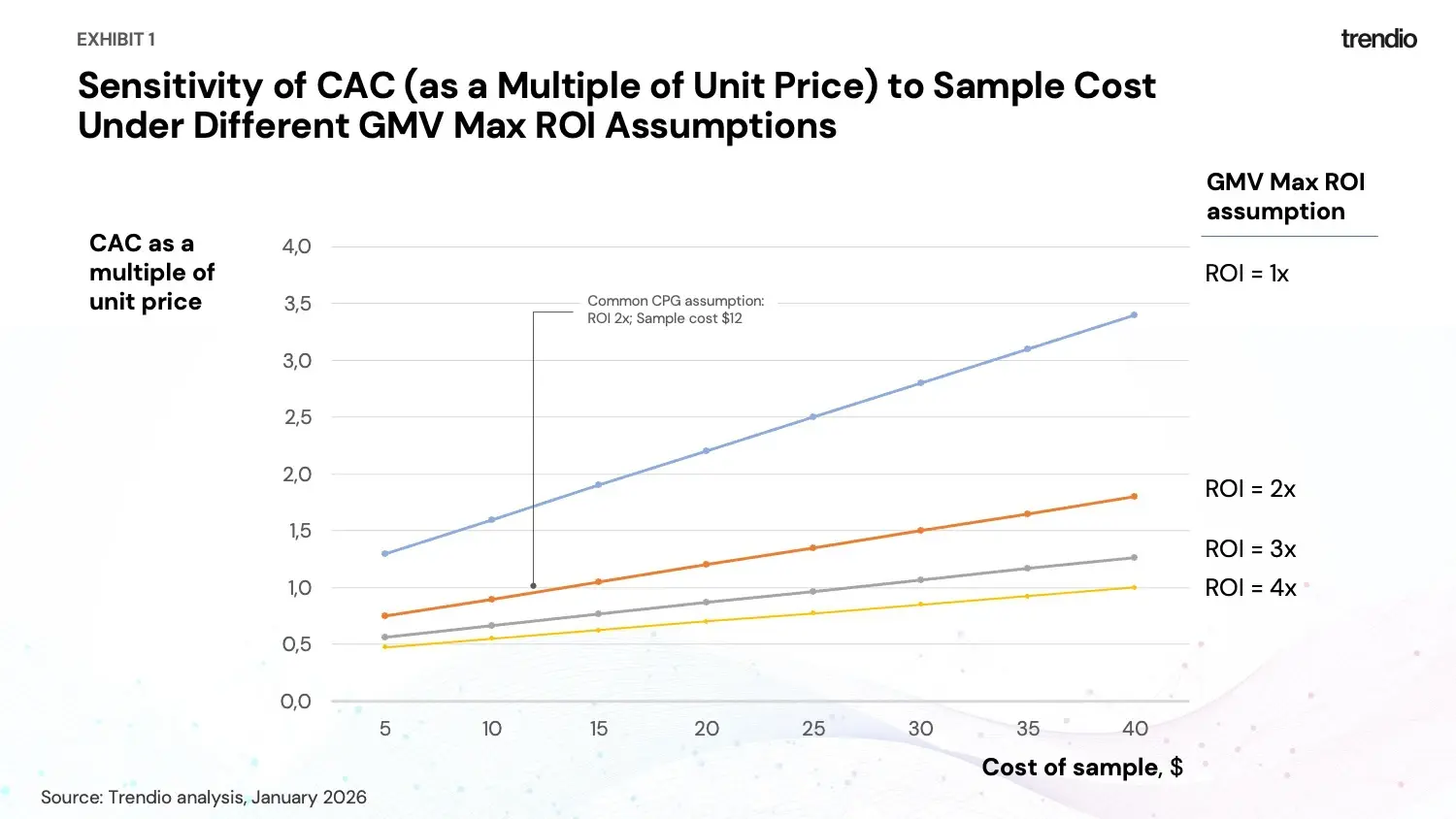
While the discussion so far has focused on the decision to enter TikTok Shop at the brand level, the same logic applies at the item level. Because the model is defined per product — incorporating unit price, sample cost, and expected GMV Max return — it can be used to evaluate whether adding a specific SKU to a TikTok Shop program is economically justified. In practice, this allows brands to assess assortment expansion decisions with the same discipline as initial channel entry.
A Practical Benchmark for Decision-Making
In practice, once realistic operating assumptions are applied to the model, useful simplifications emerge.
One common case illustrates this clearly. With a $12 sample cost and a GMV Max ROI of 2 — assumptions that are representative for many CPG brands — expected CAC is approximately equal to the unit price of the product.
This benchmark helps explain why TikTok Shop can be attractive even when ROAS appears lower than in other channels. When evaluated on acquisition economics rather than repeat efficiency, the channel often compares favorably — particularly for brands with strong margins or meaningful lifetime value.
Implications for Brand Decision-Making
The practical implication of a predictive CAC model is not simply better measurement — it is better decision-making before launch.
Brands can now estimate TikTok Shop customer acquisition cost in advance, compare it to acquisition costs in other channels, and decide whether to invest — either at the brand level or for individual products within their assortment — before committing budget, samples, or operational resources.
Where expected TikTok Shop CAC is competitive, brands can invest with conviction rather than experimentation. Where it is not, the channel may still serve specific strategic purposes, but it should not be evaluated as a primary acquisition engine.
From Experimentation to Planning
TikTok Shop is often described as unpredictable or experimental. In reality, its economics are becoming increasingly legible. Once the channel is understood for what it is — a discovery-driven acquisition engine powered by creator content — uncertainty gives way to disciplined planning.
Brands no longer need to approach TikTok Shop blindly.
The opportunity can now be assessed quantitatively, before launch.
1 See How many videos do you really need to win on TikTok Shop?, Trendio Research, 2025
Appendix: Algebraic Derivation of the CAC Model
Let:
P = Price per unit to the consumer.
SC = All-in cost of a free sample sent to creators, inclusive of product cost, picking and shipping
ROI = Expected ROI from GMV Max paid ads on TikTok Shop
CAC = Customer acquisition cost
Nb Customers = Number of customers acquired
By definition,
On TikTok Shop, over 95% of customers purchase a single item per transaction, and therefore the above equation can be written:
Revenue is a multiple of GMV Max ROI. On average, 90% of transactions on TikTok Shop are from new customers. Approximately 30% of revenue on TikTok Shop is organic. As a result:
Acquisition cost is the combination of GMV Max spend, cost of samples and commissions on the acquisition transaction:
We decompose the components below.
We know from prior research that brands need to source some 70 posts for every $1K budgeted in GMV Max ads, therefore:
and
Commissions include affiliate commissions and TikTok fees on transactions. TikTok fees run at 6%. Affiliate commissions tend to average about 14% (inclusive of sales not generated by affiliates, from product cards or brands’ own videos, and which do not carry affiliate commissions). Therefore:
Bringing it all together:
Simplifying,
And finally,
Accounting for Cross-Channel Conversion (“Halo”)
The CAC model above is intentionally conservative and considers only transactions that occur directly on TikTok Shop. In practice, a meaningful share of customers discover products on TikTok Shop but complete their purchase on another platform, most commonly Amazon. While difficult to measure precisely, practitioner estimates typically place this effect in the 10–30% range, with 20% often cited as a reasonable midpoint. Because cross-channel conversion is not directly observable for most brands, this adjustment is not included in the formula above and, if applied, should be treated as directional rather than definitive.
About Trendio
Trendio is a video shopping technology provider and agency that works with brands across categories on TikTok Shop, YouTube Shopping and video web embedding. Trendio combines proprietary AI solutions with channel expertise to identify and engage the best affiliate creators for every brand in every channel, manage their entire video creation process, optimize brands' own video posts using video AI, manage paid ads for maximum returns and deliver best-in-class tracking. For more information, visit www.trendio.ai.
About the Author(s)
Alex Perez-Tenessa is the Founder & CEO of Trendio. Prior to Trendio, he was the VP of US Prime Video at Amazon, VP of Beauty and Personal Care at CVS Health and Partner in the Retail Practice of McKinsey & Company.